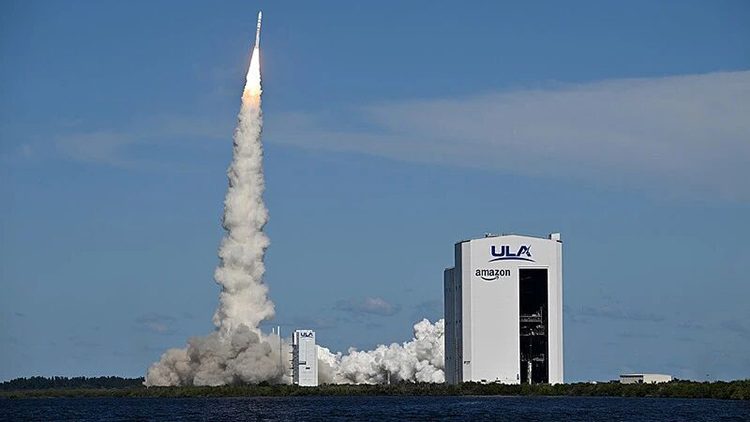
At around 6:00 am on September 16th, the Gravity One Y3 carrier rocket (YL-3Y3) was ignited and launched into the East China Sea, successfully sending eight Thousand Sail Constellation networking satellites and one ultra high speed wireless communication technology experimental satellite into the designated orbit. The launch mission was a complete success.
Just about 16 hours ago, the Zhuque-2 improved Yao-7 carrier rocket (ZQ-2EY7) successfully launched 10 satellites from the Qianfan polar orbit 19 group into the predetermined orbit.
In two days, two types of civilian and commercial rockets were launched consecutively, with the same customer as Yuanxin Satellite Company's Qianfan Constellation Network Satellite.
1、 The first batch of civil and commercial rocket networking satellite Internet
" For the first time; Words like 'first' are too easily devalued in commercial aerospace, so it is necessary to clarify the attributive.
This is the first time that China's civilian and commercial rockets have launched mass networking of low orbit Internet constellations.
Over the past two years, the launch missions of Qianfan have been almost entirely undertaken by the Long March series, with the Long March 6, Long March 8, Long March 8, and Long March 12 taking turns to launch.
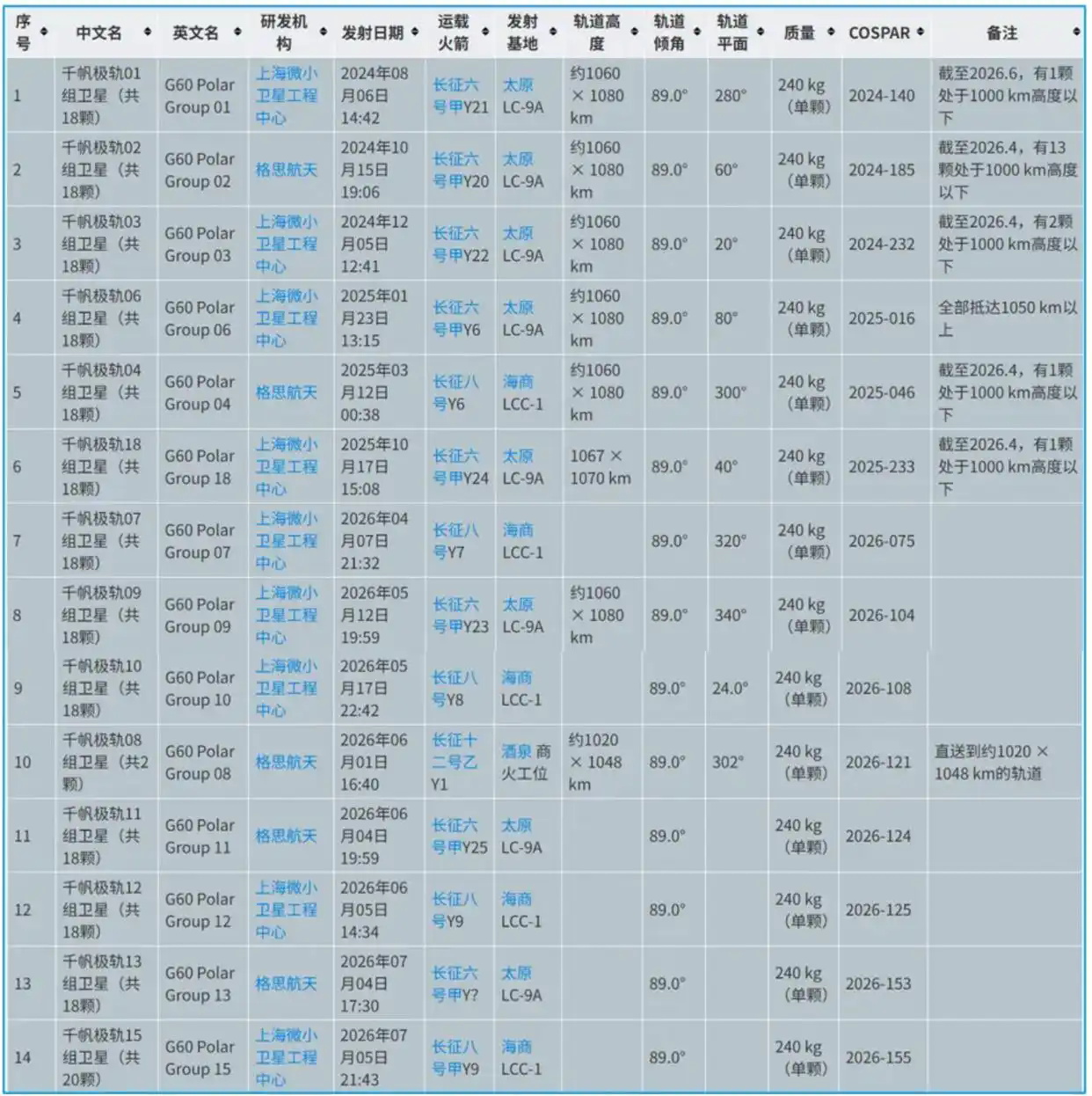
Figure/Qianfan Constellation Networking Record before September 15th (Grey Machine Wiki)
In the past, civil and commercial rockets did not fail to launch satellite Internet satellites, but they launched more test and verification satellites. For example, in June 2026, the Thousand Sail DTC01 satellite sent up by the Zhuque-2E Y-6 spacecraft of Blue Arrow Aerospace is the direct connection technology verification satellite for mobile phones.
The real threshold to cross is the mass launch of official networking satellites.
When launching multiple flat satellites at one time (low earth orbit satellite Internet constellation, 36 satellites in one orbit, separable launch), it is necessary to simultaneously solve the stack structure, satellite rocket interface, separation timing and orbit accuracy.
China's private commercial aerospace industry has been developing for over 11 years, finally ushering in the launch of a large-scale constellation network. The significant significance of the launch of Qianfan 18 stars by these two types of rockets on the 15th and 16th lies in this.
2、 Who else is waiting for the launch of the Qianfan civilian and commercial rockets?
The list of rocket service providers for Qianfan is currently being reviewed; The National Team; Becoming '; National team+civil and commercial team;.
In fact, several years ago, Yuanxin Satellite began non-public and public bidding for rocket launch services. According to the announcement of the "2025 Launch Vehicle Launch Service Procurement Project", a total of 1.336 billion yuan was allocated to bid for 7 launch services, and successful flight experience is required.
In February 2025, Yuanxin publicly launched its first tender for launch services due to the following reasons:; Less than three suppliers have registered; Failure;
In August 2025, the bidding for Launch Service Package One (one rocket with 10 stars, 616 million yuan) was announced to have failed due to insufficient number of suppliers;
Package 2 (18 stars with one arrow, 720 million yuan) has been relaxed to; Allow models that have not made their maiden flight; The bidding was successfully opened, and Blue Arrow Aerospace, Tianbing Technology, and Zhongke Aerospace ranked among the top three bidders.
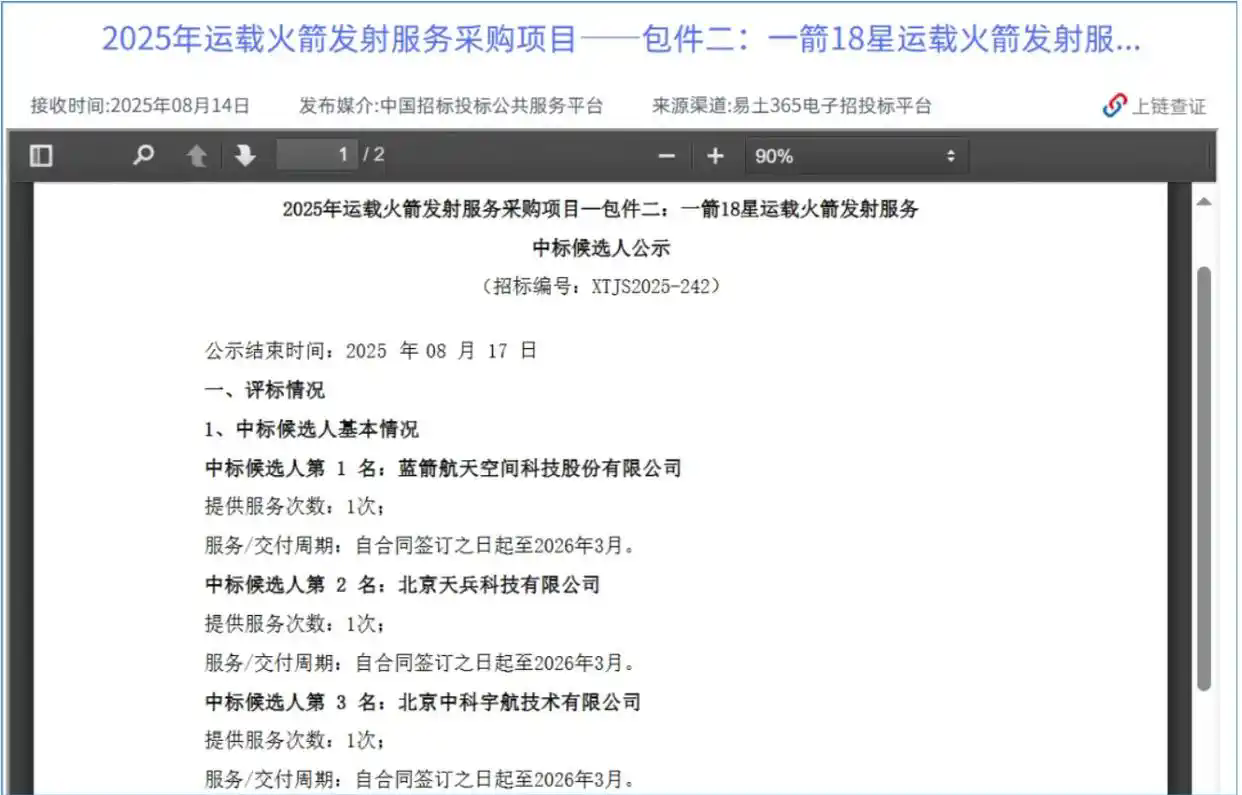
According to the bidding announcement at that time, the civil and commercial rockets that could be matched with a single rocket of 10 stars were: Zhuque 2 Improved (ZQ2-E) and Gravity 1 (YL-1).
Currently, there are Zhuque III (ZQ-3) and Lijian II (PR-2) that meet the 18 star capacity of one rocket and have successful launch cases.
Including rockets such as Zhishenxing-1, Tianlong-3, and Hyperbolic III, if their transport capacity meets the standard and they have successful launch cases, they also have the opportunity to become candidates for the Qianfan launch rocket.
PALLAS-1, also known as Zhishen Star One. On September 1st, it successfully made its maiden flight in Jiuquan, and if its transport capacity can be increased to 280 tons at an altitude of 950 kilometers, it also has the opportunity to become one of the launch service models.
Tianlong III (TL-3). The first flight failed on April 3rd, and the zeroing review was approved on September 10th. The fault was located as liquid oxygen emitted during the flight was sucked into the bottom of the arrow, causing secondary combustion of turbine exhaust gas and erosion of the heat protection structure. Tianbing Company announced that the Tianlong III remote second arrow plan will resume flight in the fourth quarter.
Hyperbolic number three (SQX-3). The plan is to make its maiden flight in Wenchang by the end of the year and simultaneously challenge for sea recovery (there is also news for early next year).
Based on this calculation, there may be 7 types of civilian and commercial rockets available for networking Qianfan next year, and their capacity and price will become the hard power in the competitive market.
3、 Qianfan's annual target is 324, with 68 stars still waiting to be shot
As of September 16, Qianfan Constellation has deployed 256 satellites, which continues to rank first in the number of domestic LEO satellite Internet networks.
The goal set by Yuanxin Satellite for the first phase is to complete the global networking of 324 satellites and synchronously launch commercial operations by the end of 2026.
There are 68 gaps and only three and a half months left.
There is a high consensus in the industry that there are no arrows available.
Among the existing Long March series rockets, there are only a few that can be used for commercial launch networking, and the number of rockets that can be allocated to the Thousand Sail Constellation is extremely limited due to the need for satellite network launch.
This judgment is not difficult to verify. As of September 16, 2026, the deployment of 226 GW constellations led by China Star Network and 256 Qianfan constellations led by Yuanxin Satellite have only completed about 1.7% of their respective total plans. Leaving aside satellite production capacity, one of the biggest bottlenecks for constellation networking is rockets, workstations, and launch windows.
This is a game with a countdown.
Implementation of the International Telecommunication Union on Frequency Track Resources; Apply first, use first; Deployment must be completed within 7 years after application, otherwise resources will be reclaimed.
4、 Time waits for no one, capital and the market are equally anxious
Although there is slight adjustment to the plan of completing the networking of 15000 satellites by 2030 (the completion time of the phases has been adjusted later), the overall goal remains unchanged.
In August 2026, Yuanxin completed a capital increase of 6.976 billion yuan, with 18 industrial capital entering the market. The post investment valuation was about 50 billion yuan, setting a new record for single financing in domestic commercial aerospace. In early September, Hangzhou Alibaba Venture Capital and SAIC Financial Holding completed their equity investments, increasing their registered capital to 2.484 billion yuan.
State owned assets, industrial capital, and international markets have entered the valuation model, and network speed and service revenue have become hard indicators.
Yuanxin has clearly set the first stop of its commercialization path overseas, obtaining regulatory permits in Brazil and launching the construction of a customs station. The customs station project in Malaysia is progressing, while business connections are being made with more than 30 countries.
And the prerequisite for these is network speed.
In addition to speed, it is also necessary to reduce the cost of single satellite and unit bandwidth to a level that can compete positively in overseas markets.
68 satellites, three and a half months, this is the remaining homework of Qianfan, and it is also one of the handover nodes of China's satellite Internet construction.