On October 5th, in Antalya. The 77th International Astronautical Congress opens here and lasts for five days. The theme of this year's conference, hosted by the International Astronautical Federation (IAF) and hosted by Türkiye's Space Agency, was "The world needs more space exploration". Space experts, scholars and entrepreneurs from more than 100 countries around the world were present. President Erdogan of Türkiye attended the opening ceremony.
The Chinese delegation is led by Li Guoping, Chief Engineer of the National Space Administration. Accompanying the delegation are China Aerospace Science and Technology Corporation and 14 private aerospace companies - together, about 200 representatives from the Chinese aerospace industry appeared in Antalya.
China has reserved three positions for international partners
During the one-on-one interview session of the conference, Li Guoping talked about China's progress in launch vehicles, deep space exploration, and space science over the past year. He then made a practical statement: China will continue to open the door to its international partners for the following deep space missions - in order, they are Xihe 2 (solar exploration), Tianwen 3 (Mars sampling and return), and Tianwen 4 (Jupiter system exploration). If there is a payload, it can be discussed.
The term 'carrying opportunities' sounds technical, and when translated into Mandarin, it means:' On our detector, we'll leave you a spot. '. Three tasks, three opportunities, anyone can come and talk.
The weight of the three tasks is not the same.
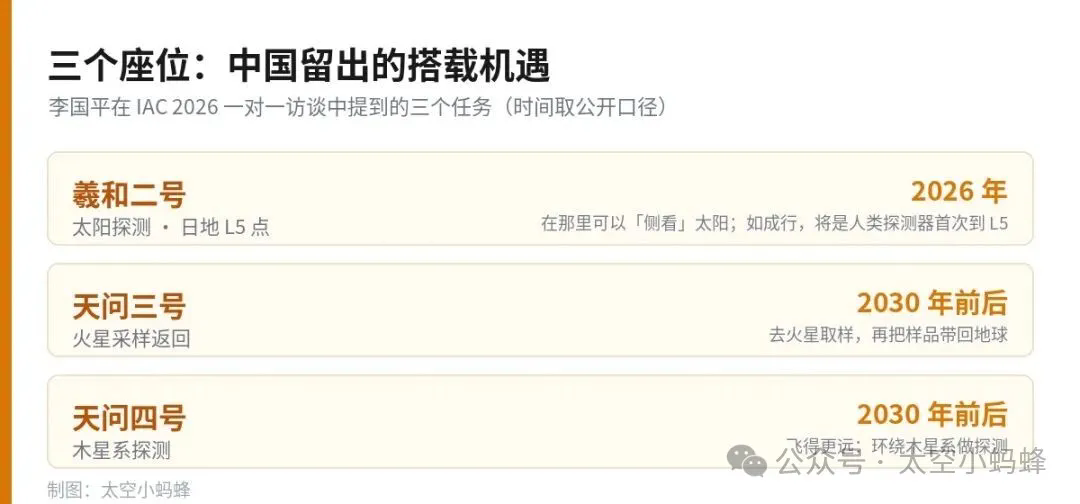
Three tasks with publicly available schedule times. Drawing: Space Wasp
Xihe 2 is going to the L5 point on the Sun Earth axis - the gravitational equilibrium point on the outer side of the line connecting the Sun and Earth, where you can "look sideways" at the Sun; According to the public plan, it will be launched in 2026. If it goes ahead, it will be the first time that humans have sent a probe to this location. Tianwen-3 is going to do even harder: take samples from Mars and bring them back to Earth - according to the schedule given in the October 10th article of People's Daily, launch around 2028 and bring the samples back around 2031. Tianwen-4 flew further with the goal of orbiting the Jupiter system for exploration.
China has walked this road and it has been successful. When Chang'e-6 went to the far side of the moon for sampling, the probe carried France's radon detector, Italy's laser angle reflector, the European Space Agency's negative ion detector, and a small satellite from Pakistan; Later, this batch of international payloads obtained data. For many countries, this is their only accessible opportunity for deep space exploration - building a probe themselves is too expensive, taking a ride is much more realistic.
A prize and a mechanism that includes China
At the opening ceremony, the 2026 International Astronautical Federation World Space Award was presented. The winner is not a scientist, but a mechanism - the International Charter: Space and Major Disasters. The China National Space Administration is a member of this charter and was also invited to attend the award ceremony.
The purpose of this constitution is clear in one sentence: wherever a major disaster occurs, satellites from all countries will turn around together to take pictures. It was initiated by the European Space Agency and the French National Centre for Space Research in 1999 and began operation in 2000. The mechanism is designed to be minimalist - disaster management agencies of affected countries apply through a single portal, with a 24/7 duty throughout the entire process, free of charge to users.
The figures best illustrate how much it has done: so far, the Charter has launched responses to more than 1000 major disasters in more than 146 countries - the Indian Ocean tsunami in 2004, the Haiti earthquake in 2010, the typhoon Haiyan in 2013, the Nepal earthquake in 2015, and the earthquakes in Türkiye and Syria in 2023 are all on the list. Floods, earthquakes, tsunamis, landslides, wildfires, volcanoes, and oil spills are all within its business scope.
Give the World Space Award to such a mechanism
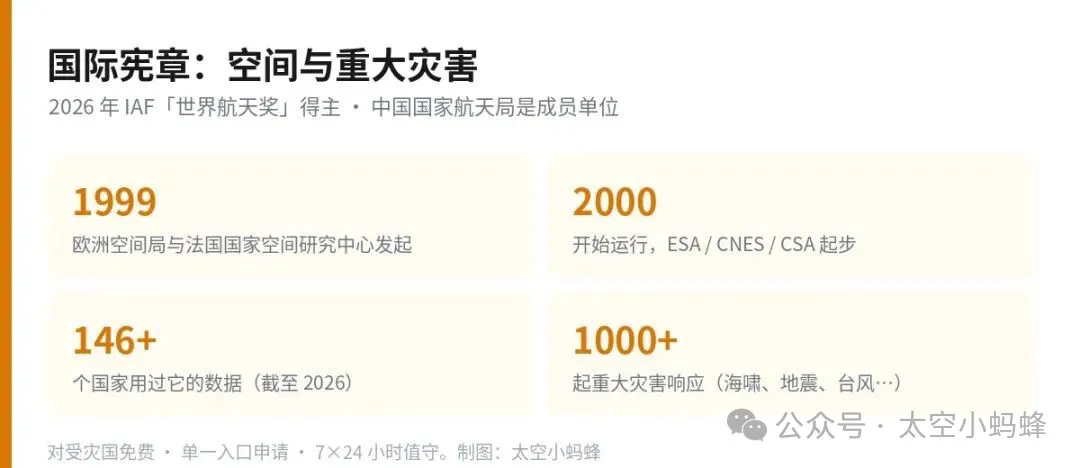 这个机制干了多少活。制图:太空小蚂蜂
, It is a statement in itself: space is not only about rockets and probes, but also a satellite network that can be mobilized within a few hours after a disaster occurs.
There are 14 private enterprises on the booth
In the Chinese exhibition area, in addition to the "national team" China Aerospace Science and Technology Corporation, there are also 14 private aerospace companies. This number itself is news.
China's commercial aerospace industry started around 2015, and within ten years, it has progressed from sounding rockets to orbital launches, satellite mass production, and recyclability tests. They appeared on the exhibition booth at the International Astronautical Congress, and the picture is not of those booths - it is of overseas customers, suppliers, and partners. For a low Earth orbit constellation era that is currently networking, the market for this type of business is global, not domestic.
Two documents, one round of talks
Before the opening of the conference, ministers and parliamentarians uploaded a "Antalya Declaration" with the theme of peaceful and sustainable use of space; China is one of the 21 signatory countries. The organizer said that this is the first time in the history of this conference that such a joint declaration has been adopted; The declaration also invites countries and international organizations that have not yet joined to sign it together.
Outside the venue, there are intensive bilateral trips. At the leadership meeting of the space agency, officials from the space regulatory agencies of the United States, Japan, India, and Canada, as well as the Director of the European Space Agency, Li Guoping, represented China at the table; And at the Global Space Leaders Summit, attended by space agency leaders from 46 countries, he talked about another thing: how China can work with international partners to address climate change and disaster prevention and reduction through bilateral and multilateral mechanisms.
During the meeting, he also held talks with representatives of eight space agencies: Türkiye, Britain, Saudi Arabia, Argentina, Brazil, Spain, Malaysia and Poland. By listing the topics of discussion, we can roughly see the focus of China's aerospace industry's current dealings with the outside world - how to build and use satellites; How to explore the moon and deep space; How to prevent asteroids; How to track space debris; How to manage spatial transportation.
The latter few are particularly noteworthy. Asteroid defense, space debris, and space traffic management are not problems that a single country can solve by closing its own doors - they inherently require rules and cooperation, and the rules are still evolving.