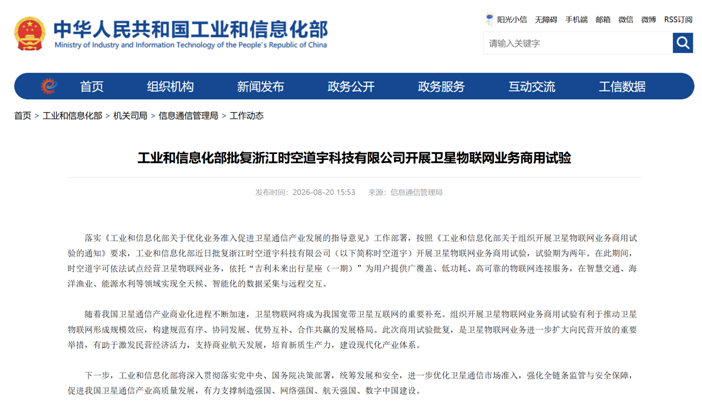
On August 20th, according to the official website of the Ministry of Industry and Information Technology, Zhejiang Spatiotemporal Daoyu Technology Co., Ltd. (referred to as "Spatiotemporal Daoyu") recently obtained the commercial trial license for satellite IoT business approved by the Ministry of Industry and Information Technology, with a trial period of two years. During this period, Time Space Daoyu can legally pilot the operation of satellite IoT services, relying on its self-developed low orbit satellite IoT constellation to provide IoT connectivity services to global users. At the same time, Time Space will conduct IoT NTN technology trials to continuously accelerate the research and commercialization process of 6G satellite communication technology.
Prior to this, at the 2026 Shanghai Mobile World Congress (MWC Shanghai), the first time in the industry to showcase the space-time constellation, the world's first low orbit communication constellation full stack open source ecosystem was officially released to the public. During the conference, cooperation intentions were reached with over 200 ecosystem partners, and on-site signed orders exceeded 100 million yuan.
From the constellation full stack open source ecosystem to the approval of the Ministry of Industry and Information Technology, two "core events" intersect, pointing to a clear signal: China's low orbit satellite IoT is entering a new stage of "large-scale commercial operation" from "technical verification".
The 'hard threshold' for commercial trial licenses and the 'watershed' of the industry
The difficulty of obtaining commercial testing licenses for satellite IoT services is extremely strict. In the "Notice of the Ministry of Industry and Information Technology on Organizing Commercial Testing of Satellite IoT Services" issued in November 2025, it is clearly stated that the applying enterprise must meet five mandatory entry thresholds at the same time: having obtained a satellite mobile frequency usage license and a space radio license; The constellation construction project has been approved by the National Development and Reform Commission; Having a satellite system that can serve in orbit and a complete set of supporting systems for ground operation control, business, and management; Having complete capabilities in network security, data security, and emergency support; We can provide long-term stable services nationwide.
This threshold has blocked the vast majority of early-stage commercial aerospace companies from entering the market.
Getting approval means three things.
Firstly, there is the legalization of identity. For a long time, domestic satellite IoT has faced the embarrassment of lacking independent business classification - management often refers to ground IoT or traditional satellite communication models, and compliance boundaries are blurred. In August 2025, the Ministry of Industry and Information Technology for the first time listed satellite Internet of Things and satellite Internet as an important business direction of satellite communication; In November of the same year, the Ministry of Industry and Information Technology launched a two-year commercial trial of satellite IoT services, clarifying the application approval process and regulatory rules during the trial phase.
Next is operational compliance. After obtaining approval, enterprises can legally carry out fee based services, sign long-term commercial contracts, and expand industry customers. The compliance path that previously troubled the industry was cleared, and the commercial closed loop was truly established.
Finally, there is a switch in the logic of competition. The Ministry of Industry and Information Technology has clearly stated in relevant approvals that organizing commercial trials of satellite IoT services is conducive to promoting the formation of economies of scale in satellite IoT, and building a standardized, orderly, collaborative, complementary, and win-win development pattern. Industry competition is shifting from the competition of "star making ability" to the competition of "operational services" and "commercial closed loop".
64 satellites and full stack self-developed capabilities: a differentiated foundation for the space-time universe
Spatiotemporal Dao Yu can become one of the few domestic enterprises that has crossed the five major entry barriers for commercial testing approval of satellite IoT business, relying on three hard core conditions: global constellation scale, full stack self-developed technology depth, and mature commercialization landing progress.
In September 2025, Spatiotemporal Space will complete the first phase of constellation networking, sending 64 satellites into orbit through 6 launches, achieving communication coverage at any location on the global surface except for the North and South Poles. All satellites have a 100% reliability in orbit. Based on existing in orbit satellites, the constellation system has the ability to process approximately 340 million communication requests per day, serving 20 million users worldwide. According to publicly available information, among commercial aerospace companies focused on global low orbit satellite IoT constellations, Spatiotemporal Space ranks second in the world and first domestically with 64 in orbit satellites.
What supports the operation of this network is a set of self-developed capabilities for the entire chain. From constellation system design, satellite research and development, mass production of AIT, constellation measurement and operation control, to core chips, modules and terminals, and industry application services, Time Space has achieved full process autonomy and controllability. Taking satellite mass production as an example, its Taizhou Satellite Super Factory has compressed the single satellite production cycle to 28 days, with an annual production capacity of 500 satellites and a 45% reduction in single satellite costs.
In terms of communication, the company adopts self-developed communication system and private protocol, and the system has a 50dB anti-interference ability; Using the UHF/VHF frequency band, it has strong penetration and resistance to rain attenuation, and the signal remains stable even in extreme weather conditions. Low power consumption and miniaturized terminal systems have provided economically feasible connection solutions for wide area IoT scenarios such as asset tracking, environmental monitoring, and pipeline inspections. These terminals are distributed in remote areas without maintenance, and can be used for several years without battery replacement, achieving long-term unmanned supervision. And in this scenario, high-power broadband solutions cannot be implemented.
This capability system points to a clear business judgment: in long-distance, uninhabited areas, or extreme weather conditions, the value of "continuous connectivity" far exceeds that of "faster". As Wang Yang, the founder of Time Space Dao Yu, said, "Commercial aerospace is an infrastructure industry that inevitably goes through three stages: capacity building, scale building, and value realization. The real watershed is no longer the number of launches or satellites, but whether the constellation network has the operational ability to continuously and stably acquire paying users and achieve long-term revenue
From open-source ecosystem to approval: Accelerating the realization of commercial closed loop
Just before the approval, the commercialization progress of Time Space Daoyu had significantly accelerated.
During MWC Shanghai, Time Space Daoyu officially released the world's first low orbit communication constellation full stack open source ecosystem, relying on a five tiered open system covering terminal hardware, standardized communication modules, self-developed satellite communication chips, satellite communication protocols, and satellite system resources, and opening up the technology base to partners across the entire industry chain such as operators, chip manufacturers, and industry integrators.
The industrial achievements obtained from this quickly became apparent: during the exhibition, Time Space Daoyu received cooperation intentions from over 200 ecological partners, and the scale of on-site signed orders exceeded 100 million yuan. Its business scope covers ten core real economy tracks, including intelligent networking, marine fisheries, engineering machinery, energy industry, low altitude economy, and smart agriculture.
In terms of globalization, the layout of Time Space Daoyu is also steadily advancing. As of now, Time Space Daoyu has focused on the Asian, African, and Latin American markets, and has reached cooperation with telecommunications operators in more than 20 countries. Recently, Time Space Daoyu has successfully obtained multiple market intention orders in the Middle East, South America, and other regions. This year, we will accelerate the landing and delivery of these orders to achieve large-scale application of overseas business.
After the approval of the Ministry of Industry and Information Technology, Time Space Daoyu is also moving from technical verification of whether it can be done to commercial applications of whether it can make money on a large scale. For Time Space Universe, approval is not the end point, but the official starting point for transitioning from being an "infrastructure builder" to a "satellite communication operator". When the industry enters the era of operation, the real question is no longer "who can create satellites" or "who can build networks", but "who can turn satellite networks into a global infrastructure that continuously generates value".