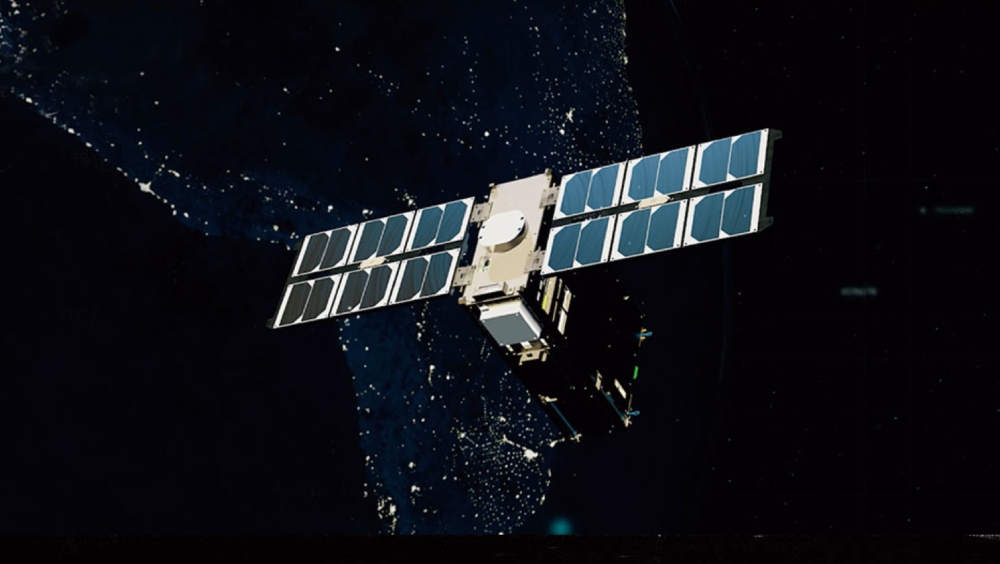
Recently, the Tianwen 1 orbiter successfully observed the interstellar object Atlas (3I/ATLAS) using a high-resolution camera. During this period, Tianwen-1 orbiter was about 30 million kilometers away from the target celestial body, making it one of the closest probes to observe the celestial body at present.
The data obtained by high-resolution cameras is received and processed by ground application systems before being displayed. The comet features of the celestial body in the image are obvious, consisting of a comet nucleus and its surrounding coma, with a diameter of several thousand kilometers. The researchers used a series of images taken continuously for 30 seconds to create an animated image showcasing the motion trajectory of the celestial body. Through these observation data, researchers are further carrying out in-depth research on Atlas.
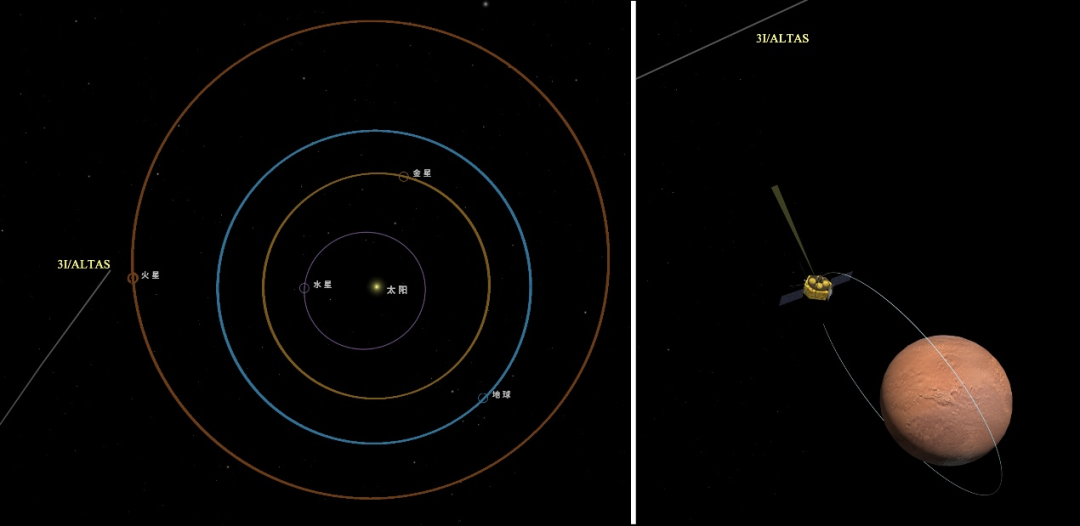
Schematic diagram of the relative position of the interstellar object Atlas and the Tianwen 1 Mars orbiter (the right picture is a partial magnification of the left picture when the camera took it on October 3, 2025)
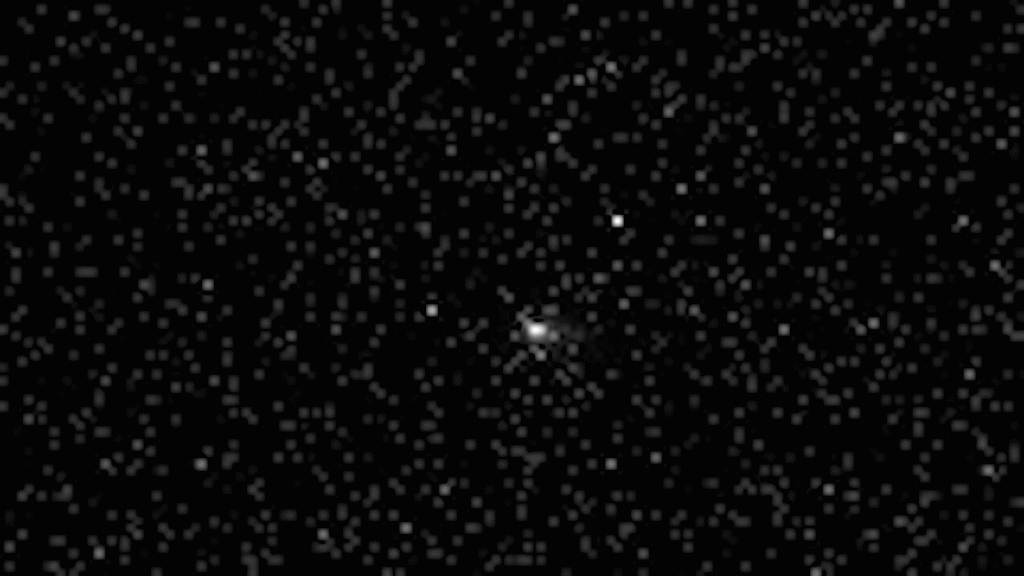
Atlas (imaging time: October 3, imaging distance: about 28.96 million kilometers) captured by the high-resolution camera of Tianwen No.1 orbiter
The successful observation of Atlas is an important expansion task of Tianwen 1. The use of detectors to observe weak objects has carried out technical tests for Tianwen 2 to carry out asteroid exploration, and accumulated experience.
Atlas, discovered by the Sky Survey Telescope in Chile on July 1, 2025, is the third interstellar object known to visit the solar system, passing through the solar system in a hyperbolic orbit. This celestial body may have formed around an ancient star at the center of the Milky Way galaxy, with an estimated age of about 3-11 billion years, possibly older than the age of the solar system. It is a rare sample for detecting the composition, evolution, and early stellar history of exoplanets and has important scientific significance.
The Tianwen 1 team began to prepare for the Atlas observation in early September. Due to its long observation distance (about 30 million kilometers), fast motion speed (about 58 kilometers per second), and relatively faster motion speed compared to the Tianwen-1 orbiter (about 86 kilometers per second), the target size is relatively small (comet nucleus diameter is about 5.6 kilometers), and the brightness observed in Mars orbit is very dark (currently not available on Earth), making it extremely difficult to capture images. This places high demands on the attitude pointing control capability and imaging strategy of the Mars orbiter.
The optical payload carried by Tianwen-1 orbiter was originally designed to capture the bright surface of Mars. This is the first attempt to capture such a distant and relatively dim target (10000 to 100000 times darker than capturing the surface of Mars). Through the collaborative research of the Tianwen 1 team, combined with Atlas's orbital characteristics, brightness characteristics, geometric dimensions, and scientific load technology capabilities of the orbiter, repeated simulation calculation and simulation deduction, completed the feasibility assessment of the observation task, determined to use the high-resolution camera carried on the Tianwen 1 orbiter, carefully designed the key imaging strategy, and finally successfully completed the observation. This time, targeting the characteristics of weak detection targets, the high-resolution camera's shooting ability will be maximized.
The Tianwen-1 probe entered Mars orbit in February 2021 and has been operating stably for 4 years and 8 months, in good condition.