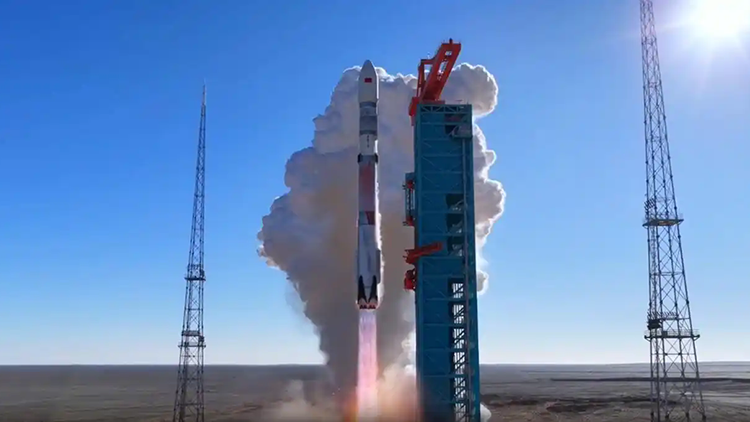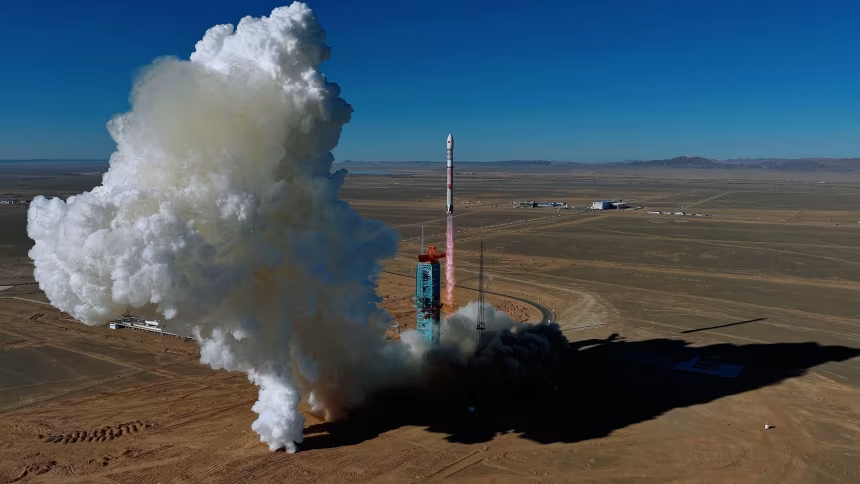
According to Xinhua News Agency, on December 3rd, the Blue Arrow Space Zhuque III reusable carrier rocket was launched into orbit, marking the first attempt at a first stage recovery carrier rocket in China and attracting widespread attention from all sectors of society. On December 6th, Blue Arrow Aerospace disclosed key technical details of a sub level recovery verification to the public.
It is reported that after completing the separation of the first stage, the first sub stage of Zhuque 3 will carry out the flight verification of vertical recovery technology as planned. The person in charge of Blue Arrow Aerospace stated that the rocket has gone through the most challenging "supersonic re-entry aerodynamic glide phase" of a reusable rocket. This stage requires crossing the maximum dynamic pressure environment, placing extremely high demands on the structural thermal protection system, overall aerodynamic layout design, and attitude control capability. The flight data accumulated during the flight process lays a solid foundation for subsequent model iteration and improvement.
At the same time, the rocket achieved high-precision guidance and control towards the landing pad recovery point during the re-entry ignition phase and aerodynamic sliding phase. The verification content includes the composite control strategy of the cold air reaction control system and the grid rudder, as well as the correctness of the corresponding guidance algorithm. This experiment further solidified the engineering practice foundation of China's liquid oxygen methane recoverable carrier rocket technology route, and explored a feasible path for China to achieve one-stage recovery.
According to previous reports, on December 3, 2025 Beijing time, the Blue Arrow Aerospace Zhuque-3 Yao-1 carrier rocket was launched into space from the Dongfeng Commercial Aerospace Innovation Experimental Zone, completing the flight mission according to the procedure, and the rocket's second stage entered the predetermined orbit. During the flight process of this mission, key actions such as rocket takeoff, first and second stage separation, second stage engine start-up, fairing separation, second stage engine shutdown, second stage taxiing, and second stage engine start-up were all completed as planned, demonstrating stable and reliable performance.
At the same time, this mission conducted flight validation of a sub level vertical recovery technology. According to flight measurement data, there was an abnormality in the ignition of the first stage of the rocket during the landing phase, which prevented a soft landing at the recovery site. The debris landed at the edge of the recovery site, and the recovery test failed. The specific cause is being further investigated.
Note: Zhuque-3 is a new generation low-cost, high-capacity, high-frequency, reusable liquid oxygen methane carrier rocket independently developed by Blue Arrow Aerospace for large-scale constellation networking tasks. It adopts a single core two-stage series configuration, with a first and second stage body diameter of 4.5 meters and a fairing diameter of 5.2 meters. The total length of the rocket is 66.1 meters, the takeoff mass is about 560 tons, and the takeoff thrust is 7542 kN
The power system of this arrow is based on the Tianque series liquid oxygen methane engine independently developed by Blue Arrow Aerospace. The first stage uses nine Tianque 12A engines in parallel; The second stage adopts a Tianque 15A vacuum engine. After interstage separation, the first sub stage of Suzaku No.3 can carry out vertical return soft landing. The designed number of times of reuse is not less than 20. When the navigation area is mature, the low Earth orbit carrying capacity is not less than 18 tons. It has the ability to deploy one rocket and multiple satellites in the Internet constellation.